 WSC60 Porsche 906 LH
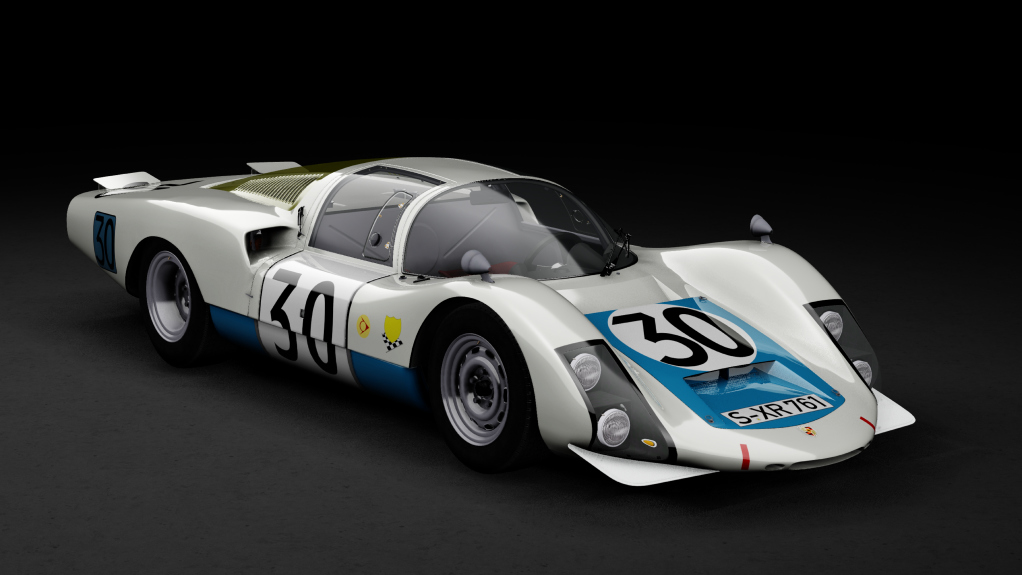
3D Model Initial conversion by: Mac Ten,
3D Model modification into LH by: Mad Agus
Skins by: Pasta
Engine Type 901/21 - Bosch fuel injection
The story of the 906 LH begins with prototype chassis 906-016, which was completed on 28th November 1965. It deviated from the production 906s with a different engine mounting position that caused it to overheat - as discovered during restoration in the mid-2000s - and lower front and rear fenders with smaller and rounded-off cut-outs that reduced its frontal area from 1.325 m2 to 1.318 m2.
In February 1966, Porsche decided to use this chassis for evaluating various different bodywork configurations in the TH Stuttgart wind tunnel. One of the main goals of these experiments was to evaluate various different front and rear spoilers and their impact on aerodynamic lift and drag. Among these was a long tail designed by Eugen Kolb, fitted to the car when revealed to the public at the Le Mans test day in April 1966. It was accompanied by two short tails (one fitted with an injection engine). Porsche only used this chassis for testing, reverted it to a short tail again, and sold it in 1967 to Wolfgang Bock (who then loaned it to Luigi Taramazzo for racing).
For the 24 Hours of Le Mans, three new cars were purpose-built as a 906 LH, 906-151, 906-152, and 906-153. While the Le Mans scrutineering weight of the 906 K was 613 kg, the 906 LH with its longer nose and very long tail weighed 637 kg. The longtail models were labeled 906 LH (Langheck, long tail in German), or sometimes referred to as 906 LM as they were made for Le Mans.
While the best static wind tunnel configuration had netted a drag coefficient of 0.306, that value rose to 0.326 in reality, because the bottom plate was removed for better transmission cooling. The initial body configuration from the Le Mans Test without spoilers had displayed a very dangerous rear end stability due to excessive lift. However fitting the spoiler of the short-tailed model was too much as it reversed the issue into making the car too light on the nose. A satisfactory behaviour was finally achieved by combining small front spoilers (canards) with two small rear spoilers. Nevertheless, at high speed the low drag long tail still generated lift, which made the car go fast on the straight, but dangerous to drive.
At Le Mans, this configuration was 15 to 20 km/h faster than a regular 906, but this car was a one trick pony. Its heavier and larger bodywork made it far more cumbersome to navigate corners with, and this was agrravated by the significantly narrower wheels that had to be fitted to the 906 LH because the usual 906 K racing tyres did not fit under the downsized wheelarches of the LH. With these limitations in mind, the factory only used the car for two WSC events in which it performed superbly.
- 1966 Le Mans 24 Hours: class podium lockout in P 2.0 and overall P4, P5 and P6 behind the three surviving Ford GT40 Mk II entries
- 1966 GP of Hockenheim: overall podium lockout (1st, 2nd and 3rd)
With a little over 5000 km on the clock, all three cars were handed over to the Sales department on 1st September 1966 and soon found new owners.
906-151 was sold to Charles Vögele and wrecked on debut in the 1967 Daytona 24 Hours, sent back to the factory for inspection, and scrapped.
906-152 was sold to King Hussein of Jordan alongside 904/8 Chassis 904-008, who later returned both to the Porsche works museum in exchange for a new 930.
906-153 was sold to Squadra Tartaruga and raced extensively in 1967, then sold to French hillclimber Jean Clément who put a short tail on it and crashed it hard on 20th October 1968. It changed hands several times in France and was modified extensively until it was sold to a collector in the USA, who had it restored to its Long Tail shape again by 1990.
Setups
There are no setups for this car.
Sessions
This car has been used in 0 sessions.
Tyres
- LM60 (V)
Specs
- Acceleration: ---
- BHP: 220 bhp
- Power Ratio: 2.9 kg/hp
- Top Speed: 280+ km/h
- Torque: 210 Nm
- Weight: 637 kg
About
- Author: Mac Ten, Mad Agus & Team WSC Legends
- Brand: WSC60 Legends
- Class: Prototype 2000
- Country: Germany
- Year: 1966
- Version: 1.3