 WSC60 Alpine A211
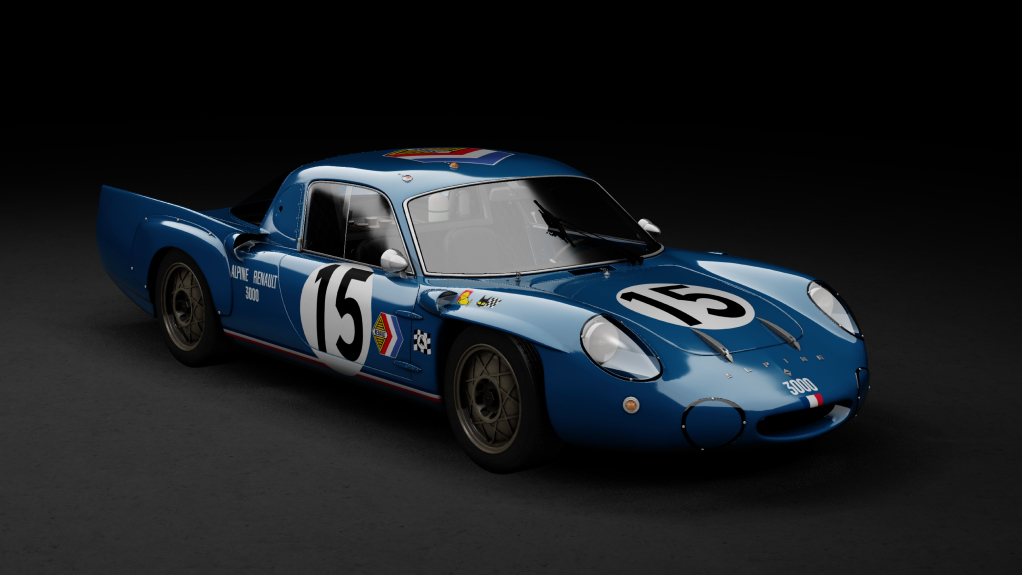
3d Model scratch built by: NPanic
How to drive this car:
- embrace the imperfections: the real thing was a stopgap testmule
- brake early, because the brakes & tyres from the A210 are overwhelmed by the speed & weight
- the engine breaks when you exceed 7200 rpm, so baby it
- your tank capacity remains at 79L because the chassis limits the tank to less than the 1300cc limit (80L)
----------------------------------------------
- Engine: 2996cc Gordini Type 62A cast-iron DOHC V8 16V
- Power: "311hp @ 7800rpm" but above 7200 rpm it was destroyed by vibrations!
- Fuel capacity: 79 Liters because the reworked A210 chassis could not hold a bigger tank
- V8 engine adds 57 kg of weight
- No brake upgrades over the A210! They were overwhelmed.
- ZF 5 DS-25 transmission, because the Porsche Type 901 gearbox was too weak for the Type 62A V8
1968 was a revolutionary year for Alpine in Dieppe. It all began in the autumn of 1967 when Gordini delivered his 3,000cc V8 engine. Immediately mated to an A210 (chassis 1727), the ‘A211’ was shaken down at Michelin’s test track in Ladoux, before taking on Montlhéry’s concrete and asphalt in the Paris 1,000km on October 15. Grandsire and Bianchi finished seventh overall with this car,which – in another essential innovation – was equipped with slick Michelin radial tyres. Even Général de Gaulle was stopped in his tracks by the
A211 when it featured on the Renault stand at the Paris Motor Show. The French President asked Jean Rédélé: “What purpose does motor racing serve?” To which the brand’s founder replied: “To put France on top, General!'
The A211 – soon affectionately nicknamed ‘La Grand-Mère’ (grandmother) – went on to compete in the Sebring 12 Hours (USA), the Monza 1,000km (Italy), the Nürburgring 1,000km (Germany) and the Spa 1,000km (Belgium), before making way for the A220 which appeared for the first time at August’s Zeltweg 1,000km, in Austria.
The cars were supposed to have participated in the Le Mans 24 Hours in June, of course, but – fortunately for Alpine – the 1968 spring uprising caused the event to be postponed until September, allowing the company’s mechanics to finish assembling the cars in the Normandy countryside, given that the factories had all been taken over. Despite – or perhaps because – of these conditions, the four A220s produced only average performances in the uncharacteristically autumnal Le Mans 24 Hours.
The chassis had been developed in haste and without a proper budget, while poor high-speed stability required the fitment of a special aero device, and the Gordini engine caused big vibrations in addition to being underpowered compared to the opposition. In short, it was a failure, and one that was made even more painful by Mauro Bianchi’s terrifying accident that left the A220 driver with serious burns, whilst his brother Lucien won in his Ford GT40. Amidst all of this misery and misfortune, Alpine was nonetheless able to take some comfort from a one-two finish in the Performance Index classification ed by rally drivers Jean-Claude Andruet/Jean-Pierre Nicolas in a 1,000cc A210 (chassis 1725), as well as victory in the Efficiency Index thanks to Jean-Luc Thérier/Bernard Tramont in a 1,300cc A210 (chassis 1721).
The three-litres cars gained their revenge in the following month’s Paris 1,000km, where the two A220s finished fourth and sixth overall. Then, on October 20, driver-cum-engineer André de Cortanze took an outright win in the Grand Prix de Casablanca, Morocco, driving an A220.
Setups
There are no setups for this car.
Sessions
This car has been used in 0 sessions.
Tyres
- GT60 (V)
Specs
- Acceleration: ---
- BHP: 281 bhp (before destructive vibrations begin)
- Power Ratio: 2.41 kg/hp
- Top Speed: 304 km/h (before reaching damage rpm level)
- Torque: 291 Nm
- Weight: 677 kg
About
- Author: NPanic & Team WSC Legends
- Brand: WSC60 Legends
- Class: Prototype 3000
- Country: France
- Year: 1967
- Version: 1.3