 WSC60 Alpine A210 1500cc
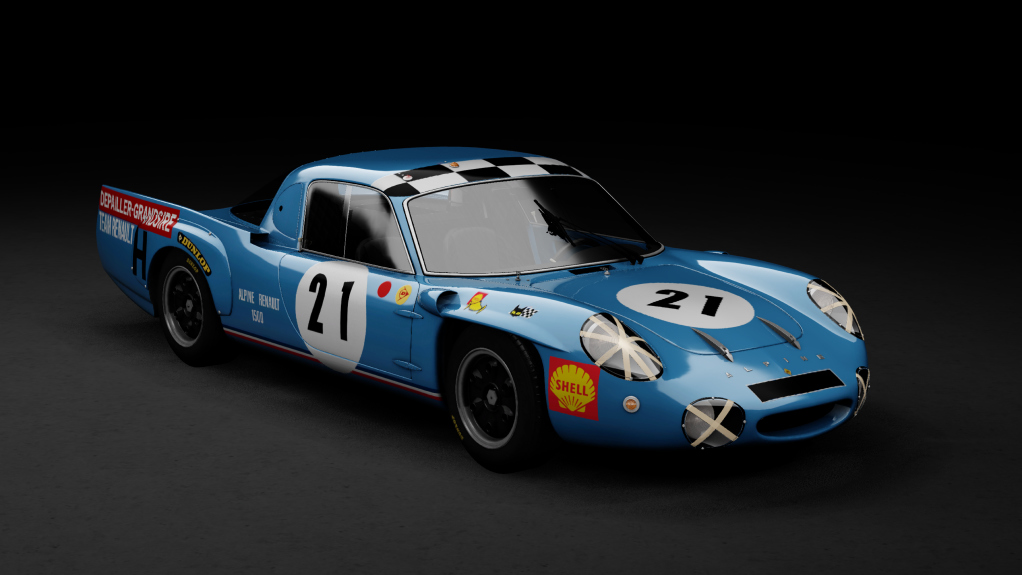
3d Model scratch built by: NPanic
1470cc Gordini Type 58C engine: 156hp @7000rpm
17 l/100 km at Le Mans 1967
The Alpine A210 was a sports car prototype that competed in sports car racing from 1966 to 1969. The car is derived from the M series prototypes (M63, M64, and M65) introduced by the company in the early 1960s and powered by Gordini-tuned Renault engines with small displacements.
In 1962, the founder and chief of the Société des Automobiles Alpine, Jean Rédélé, with the support of Shell, requested to Renault Gordini-tuned engines for a sports car programme centred on the 24 Hours of Le Mans, similar to the ones used by BP-sponsored rival Bonnet. Rédélé got a 1-litre inline-four engine and his objective was to build a prototype capable of winning the index of performance award. He contacted Colin Chapman for the design, with the idea of mounting the engine on a Lotus 23-based car, but the latter refused and the basic design development was left in charge of British engineer Len Terry, who created a concept similar to the Lotus.
The final chassis design was made by heavy vehicle engineer Richard Bouleau and the external design by Bernard Boyer. The new car was named M63, and, although having some structural problems, it won a class victory in its competition debut at the 1963 edition of the Nürburgring 1000 km. At the 1963 24 Hours of Le Mans, however, none of the three M63s entered finished the race.
After the problems encountered, Alpine built three units of a revised model based on the M63, named as M64. The new cars were entered alongside some of their predecessors into the 1964 24 Hours of Le Mans where an M64 powered by a 1.1-litre engine won its class and the index of performance. An M64 also won its class at the 12 Hours of Reims of that year. In 1965, Alpine introduced yet another revised version of its prototypes, named as M65. At the 1965 24 Hours of Le Mans, none of the Alpine prototypes entered finished the race, although M65s won their class at the 12 Hours of Reims and the Nürburgring 1000 km.
Following the Le Mans results, Alpine decided to overhaul completely its prototype design and introduced the Alpine A210 (although some lightly modified M65s also participated in some races badged as A210). In the 1966 24 Hours of Le Mans, Alpine made a 1-2-3 in the energy efficiency index, with speeds of up to 270 km/h using a 1.3-litre engine. An A210 driven by Mauro Bianchi won the overall classification of the 1966 Macau Grand Prix for touring cars.
Rédéle used the results to convince Renault of giving him support for the construction of a car aimed at the overall victory in Le Mans. Gordini was commissioned to build a new 3-litre V8 to be fitted on the A210 chassis, although it would not be ready for the 1967 edition. Before the race, the A210 was used for the early test of the first radial treadless tire for racing (the Michelin A1). At the 1967 24 Hours of Le Mans, the official Alpine team and the satellite Écurie Savin-Calberson entered with seven A210 (five with the 1.3-litre inline-four engine, one with a 1.5-litre engine and one with a 1-litre engine) and a M64 (with a 1-litre engine). A 1.3-litre and the 1.5-litre A210s won their class, although none get an index win.
Setups
There are no setups for this car.
Sessions
This car has been used in 0 sessions.
Tyres
- GT60 (V)
Specs
- Acceleration: 6.9s 0-100
- BHP: 156 hp
- Power Ratio: 3.97 kg/hp
- Top Speed: 275+ km/h
- Torque: 169 Nm
- Weight: 620 kg
About
- Author: NPanic & Team WSC Legends
- Brand: WSC60 Legends
- Class: Prototype 1600
- Country: France
- Year: 1966